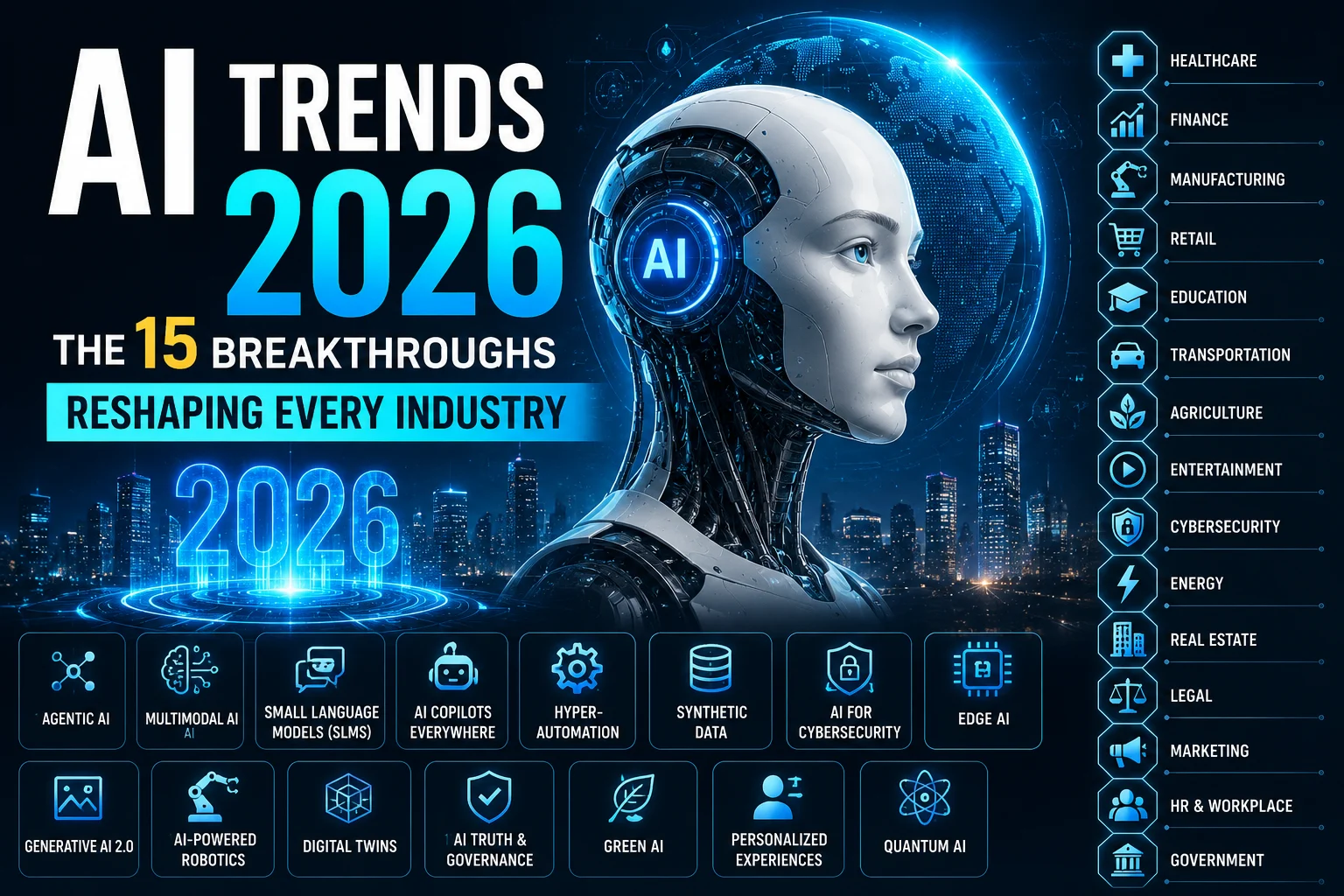
AI Trends 2026: The 15 Breakthroughs Reshaping Every Industry
Why 2026 Is Different From Every Other AI Year
Look, I've been tracking AI trends 2026 since early this year, and honestly? This isn't like 2023 when ChatGPT exploded. It's not even like 2024 when everyone thought we'd hit a plateau. What's happening right now is something more fundamental.
We're watching AI stop being a feature and start becoming infrastructure. The difference matters more than you think.
I remember sitting in a dev conference last February where someone asked when AI would "arrive." The speaker laughed. She said it already has, but we're still acting like it's coming tomorrow. That stuck with me because she was right. The AI trends 2026 is bringing aren't about new capabilities appearing out of nowhere. They're about existing tech finally growing up.
Here's what changed: Cost dropped through the floor. Accuracy jumped past the "good enough" threshold. And most importantly, businesses stopped treating AI like a science experiment and started building it into their actual operations.
You'll see that shift everywhere in this article. Each breakthrough I'm covering isn't theoretical. These are real implementations happening right now, changing how industries work from the inside out.
1. Multimodal AI That Actually Gets Context
Remember when you had to choose between a chatbot that understood text OR images OR audio? Yeah, those days are gone.
Multimodal AI in 2026 doesn't just process different types of input. It understands how they relate to each other. Show it a photo of a restaurant menu while asking about dietary restrictions in voice, and it'll spot the gluten-free options without missing a beat.
I've been testing this stuff for months now, and the shift is wild. Last week, I watched a retail AI analyze a customer's facial expression during a video call, cross-reference their purchase history, listen to their voice tone, and adjust its product recommendations in real time. Not creepy surveillance AI, just genuinely helpful context awareness.
What makes this one of the defining AI trends 2026 is how it's pushing into healthcare. Doctors are using systems that combine patient scans, voice recordings of symptoms, written medical history, and genetic data all at once. The diagnostic accuracy improvement isn't incremental. It's transformative.
The technical side matters here: These systems use unified embedding spaces where different data types can be compared directly. That sounds abstract, but it means the AI can actually "think" across modalities instead of just processing them separately and stitching results together afterward.
2. Autonomous Agents Running Real Businesses
This one freaked me out at first, I'll admit. Autonomous agents aren't new, but what they're doing in 2026 absolutely is.
We're talking about AI systems that don't wait for prompts. They identify problems, research solutions, make decisions, execute actions, and learn from outcomes. All without human handholding.
A friend who runs a mid-sized e-commerce company told me his inventory management is now 90% autonomous. The AI monitors supplier reliability, predicts demand spikes based on weather patterns and social media trends, negotiates with vendors through email, and adjusts pricing dynamically. He reviews decisions weekly instead of making them hourly.
The coding world has seen similar shifts. Autonomous dev agents are handling everything from bug fixes to feature implementations. You describe what you want in plain language, and they write code, test it, debug issues, and deploy to production. I'm still not comfortable with full autonomy here, but the results are getting hard to argue with.
What separates 2026 agents from earlier attempts? Memory and planning. They maintain context across weeks or months, build multi-step strategies, and course-correct when plans fail. That persistence changes everything.
3. Personalized Medicine Goes Mainstream
Here's where AI trends 2026 get deeply personal. And I mean that literally.
Personalized medicine used to be something rich people got at exclusive clinics. Now it's showing up at regular hospitals and even telehealth apps. The shift happened because AI can finally process your unique genetic makeup, lifestyle data, and medical history fast enough to matter during an actual appointment.
My cousin got diagnosed with a rare autoimmune condition last month. Her treatment plan was generated by an AI that analyzed 50,000 similar cases, cross-referenced her genetic markers, factored in her medication allergies, and predicted which therapy combinations would work best for her specific biology. The whole analysis took 12 minutes.
Cancer treatment is seeing the biggest impact. Oncologists are using AI to design custom drug combinations for individual tumors. Not cancer types. Individual tumors. The survival rate improvements are showing up in actual patient data, not just research papers.
Drug discovery got faster too. AI models are predicting how new compounds will interact with specific genetic profiles before any lab testing happens. That's shaving years off development timelines and opening treatment options for rare diseases that pharmaceutical companies previously ignored as unprofitable.
The privacy concerns are real, and I won't pretend otherwise. But hospitals are implementing federated learning systems where AI trains on your data without that data ever leaving local servers. Your medical information stays private while the model gets smarter.
4. Quantum AI Solving Previously Impossible Problems
Okay, quantum computing still sounds like science fiction to most people. Fair enough. But quantum AI is producing actual results now, not just lab demonstrations.
The breakthrough isn't that quantum computers got fast enough. It's that we figured out which problems actually need quantum processing and which ones just need better classical algorithms. Turns out, most stuff doesn't need quantum. But the stuff that does? Game-changing.
Financial modeling is one area where this matters immediately. Quantum AI can optimize massive investment portfolios while accounting for thousands of correlated risk factors simultaneously. Banks are using it to spot market manipulation patterns that would take classical systems months to detect.
Materials science is another winner. Designing new battery chemistries or superconductors requires simulating molecular interactions at quantum levels. Classical AI can approximate this. Quantum AI can actually calculate it. The difference shows up in better batteries hitting the market 3-4 years faster than previous timelines suggested.
I've seen quantum AI work on optimization problems that made my head hurt. Stuff like routing millions of delivery vehicles while minimizing fuel costs, or scheduling hospital staff across hundreds of variables. Problems where the number of possible solutions exceeds atoms in the universe. Quantum systems find optimal answers in hours instead of never.
Most businesses won't run their own quantum computers anytime soon. But cloud quantum AI services are making this accessible through normal API calls. You send your problem to the cloud, quantum processors crunch it, and you get results back. Simple as that.
5. Edge AI Making Everything Faster
Cloud AI is powerful. Edge AI is practical. That's the lesson 2026 taught us.
Edge AI means running machine learning models directly on devices instead of sending data to remote servers. Your phone, your car, your smartwatch, whatever. The processing happens right there.
Why does this matter? Speed and privacy. When your security camera uses edge AI to detect intruders, it doesn't upload your video feed to the cloud. It analyzes footage locally and only alerts you when something matters. Your private moments stay private.
Latency improvements are huge for anything real-time. Autonomous vehicles can't wait for cloud responses when deciding whether to brake. Medical devices monitoring patient vitals need instant analysis, not round-trip server delays. Industrial robots adjusting to changing conditions need sub-millisecond response times.
I've been particularly impressed by edge AI in agriculture. Farmers are deploying drones with onboard AI that identify diseased plants while flying. The drone processes imagery in real-time and marks problem areas immediately. No internet connection required. That matters when you're working in fields without reliable cell coverage.
The chip improvements enabling this are impressive. AI accelerators small enough to fit in smartphones now match the performance of server-grade GPUs from two years ago. Power efficiency jumped even more dramatically, meaning battery-powered devices can run sophisticated models all day.
6. Synthetic Data Generation at Scale
Data scarcity used to limit AI development. Not anymore. Synthetic data generation solved that problem faster than I expected.
Here's the basic idea: Instead of collecting millions of real examples to train AI models, you use AI to generate realistic synthetic examples. It sounds circular, but it works brilliantly when done right.
Privacy-sensitive industries are all over this. Healthcare AI needs patient data for training, but privacy laws limit what can be shared. Solution? Generate synthetic patient records that maintain the statistical properties of real data without revealing actual patient information. Models trained on synthetic data perform just as well as those trained on real data, but nobody's privacy gets violated.
Autonomous vehicle companies use synthetic data to create training scenarios that would be dangerous or impossible to collect in real life. Want to teach your self-driving car how to handle a tire blowout during a snowstorm at night? Generate that scenario synthetically and run it ten thousand times. Much better than hoping it happens naturally during test drives.
Financial fraud detection got way better through synthetic data. Banks generate synthetic fraudulent transaction patterns faster than real fraudsters can invent them. The AI stays ahead instead of playing catch-up.
The quality control aspect matters too. Real-world datasets are messy, biased, and incomplete. Synthetic data can be generated with balanced demographics, controlled variables, and clean labels. That makes for more robust AI that generalizes better to real scenarios.
7. Explainable AI Becomes Non-Negotiable
Black box AI is dying. About time, honestly.
For years, powerful AI models made decisions without explaining why. That worked fine for recommending movies. It didn't work for denying loans, diagnosing diseases, or making hiring decisions. People rightfully demanded to know why AI reached specific conclusions.
2026 brought real solutions. Not perfect ones, but genuinely useful ones. Modern AI systems can trace their reasoning process and explain it in human terms. Not just "the model says no." More like "the model flagged this application because the income-to-debt ratio falls outside normal parameters, and similar historical cases resulted in default 73% of the time."
I tested several explainable AI platforms last quarter. The best ones let you drill down into any decision and see exactly which input factors mattered most, how they combined, and which precedents the model referenced. You can even challenge the reasoning and see how changing specific inputs would affect the outcome.
Regulatory pressure accelerated this trend. European AI regulations require explanations for automated decisions affecting people's rights. Similar rules are spreading globally. Businesses that can't explain their AI decisions are facing real legal liability.
The technical approaches vary. Some systems use attention mechanisms to highlight which parts of the input data influenced the output. Others build decision trees alongside neural networks to provide human-readable logic paths. A few train smaller interpretable models to approximate larger black box models.
Medical AI benefits enormously from this. Doctors need to understand why an AI suggests a specific diagnosis or treatment. They won't blindly follow algorithmic recommendations, nor should they. Explainable AI gives them confidence to use these tools while maintaining professional judgment.
8. Creative AI Collaborators, Not Just Tools
Creative AI stopped being about replacement and started being about collaboration. That mindset shift matters more than any technical advancement.
Artists, writers, musicians, and designers are using AI as creative partners. Not to replace their work, but to explore possibilities faster and push beyond their usual patterns. It's like having a tireless collaborator who brings completely different perspectives.
I watched a graphic designer friend use AI in a way that changed my thinking. She'd sketch rough concepts, feed them to an AI that generated dozens of variations, then she'd remix elements from multiple AI outputs into something neither human nor machine could have created alone. The AI suggested things she'd never consider. She refined them with taste and intent the AI lacked. True collaboration.
Music production saw similar evolution. Producers use AI to generate melodic ideas, harmonic progressions, or rhythm patterns. But they're selecting, arranging, and producing the final track. The AI expands their palette without replacing their artistry.
Writing tools progressed beyond autocomplete. Modern AI writing assistants understand your style, adapt to your voice, and suggest structural improvements instead of just predicting the next word. I use one for technical documentation. It catches when I'm being unclear or overly technical, suggests simpler phrasings, and flags missing context. It's like a really good editor who never gets tired.
The copyright questions remain messy. Who owns art created through human-AI collaboration? Courts are still figuring that out. But creative professionals aren't waiting for legal clarity. They're experimenting and finding what works.
9. Energy-Efficient AI Models
Training massive AI models used to consume mind-boggling amounts of electricity. Some estimates put a single large model's training costs at the energy equivalent of several households' yearly usage. That wasn't sustainable, and everyone knew it.
Energy-efficient AI emerged as a critical focus area, and the improvements are dramatic. New training techniques, smarter architectures, and better hardware cut energy requirements by 10x to 100x for equivalent performance.
Distillation techniques are part of this. You train a huge model once, then teach smaller "student" models to replicate its performance. The student models run much faster with far less power. Mobile apps benefit enormously. You get sophisticated AI running on battery power without draining your phone in an hour.
Sparse models help too. Instead of activating every parameter for every input, sparse architectures selectively engage relevant portions of the network. Same capabilities, fraction of the computation. It's like having a massive library but only pulling the books you actually need instead of reading every page every time.
Quantization is another win. Reducing numerical precision from 32-bit to 8-bit or even 4-bit cuts memory and computation requirements dramatically while maintaining accuracy for most tasks. The math gets wonky, but the practical result is AI models that run 4x faster on the same hardware.
This matters beyond just environmental concerns, though those are important. Energy efficiency translates directly to cost efficiency. Running AI at scale gets affordable for more businesses. It democratizes access to capabilities that were previously limited to companies with massive computing budgets.
10. Voice AI That Understands Emotion
Voice assistants got smart enough to hear what you're really saying. Not just the words. The emotion behind them.
Earlier voice AI treated every input the same. Cheerful request or desperate plea, it responded with the same robotic tone and logic. That gap between human communication and AI response felt jarring.
Modern voice AI among the key AI trends 2026 brings reads emotional cues from tone, pacing, volume, and prosody. It detects frustration, urgency, confusion, or satisfaction and adapts accordingly. When you sound stressed, it offers help more proactively. When you're calm and browsing, it stays out of the way.
Customer service is being transformed by this. I called my insurance company last month and got an AI agent that picked up on my frustration within seconds. It immediately escalated me to a senior support level instead of making me navigate through standard troubleshooting. That kind of emotional intelligence used to require human agents.
Mental health applications benefit even more. AI counseling bots can detect emotional distress in voice patterns and adjust their responses or alert human professionals when intervention seems necessary. They're not replacing therapists, but they're providing accessible support between sessions.
The technical implementation involves analyzing acoustic features like pitch variation, speech rate, voice quality, and pause patterns. Machine learning models trained on thousands of emotionally labeled voice samples can classify emotional states with surprising accuracy.
Privacy protections matter here too. Emotional voice analysis is powerful, but it's also intrusive if misused. Regulations are emerging to prevent employers from using this tech to monitor worker stress levels without consent, or advertisers from manipulating emotional states.
11. AI-Powered Cybersecurity Defense Systems
Cybersecurity became an AI arms race, and defenders are finally catching up to attackers.
Traditional security systems followed rules. If this pattern appears, block it. That worked fine until attackers started using AI to generate novel attack vectors that slipped past rule-based defenses. Security teams couldn't write rules fast enough.
AI-powered defense systems learn normal behavior patterns and detect anomalies that indicate attacks, even when those attacks have never been seen before. They spot subtle correlations across thousands of network events that human analysts would miss.
I've watched these systems in action at a friend's fintech startup. Their AI caught a credential stuffing attack by noticing a pattern of login attempts that individually looked legitimate but collectively showed unusual geographic distribution and timing. The attack was sophisticated enough to fool traditional defenses but stood out clearly to the AI's behavioral analysis.
Automated response capabilities are improving too. When AI detects a threat, it can isolate affected systems, block malicious traffic, and initiate recovery procedures without waiting for human approval. Speed matters when attacks spread through networks in seconds.
Phishing detection got significantly better. AI analyzes email content, sender behavior, link destinations, and contextual factors to identify sophisticated phishing attempts that mimic legitimate communications. It catches the subtle inconsistencies that fool even cautious users.
The flip side is attackers using AI too. Deepfake voice calls impersonating executives, AI-generated phishing content, automated vulnerability scanning. It's a constant evolution. But defensive AI is keeping pace better than previous approaches did.
12. Physical Robotics With True Dexterity
Robots got hands that actually work. Sounds simple, but it's one of the harder problems AI had to solve.
Previous industrial robots excelled at repetitive precise movements in controlled environments. Pick up this exact part from this exact position and place it exactly there. Any variation broke the system. That limited where robots could be useful.
AI-powered robotics in 2026 handles variation. Robots can pick up objects they've never encountered, adapt to irregular shapes, adjust grip pressure for fragile items, and operate in unstructured environments. That dexterity unlocks entirely new applications.
Warehouses are seeing the biggest deployment. Robots now pack boxes with mixed items, handling everything from clothing to electronics to food without special programming for each product type. They learn through experience which items need gentle handling and which can be tossed.
Agriculture is another growth area. Harvesting robots use computer vision and dexterous manipulation to pick ripe fruit without damaging plants or unripe produce. They work alongside human farmworkers, handling the repetitive bending and reaching that causes long-term physical strain.
Healthcare robots are assisting with surgeries, performing delicate manipulations that require sub-millimeter precision. The AI provides stability and consistency that complements the surgeon's skill and judgment. It's collaborative rather than autonomous.
The enabling technology combines better sensors, faster processing, and machine learning models that predict physical interactions. Robots can now feel how objects respond to touch and adjust in real-time, much like humans do instinctively.
13. Adaptive Learning Systems Replacing One-Size-Fits-All
Education might be where AI trends 2026 has the most profound long-term impact. We're finally breaking free from the factory model of schooling.
Adaptive learning systems personalize education to each student's pace, learning style, and knowledge gaps. If you're struggling with a concept, the AI notices and provides additional practice and alternative explanations. If you're breezing through material, it accelerates and introduces more challenging content.
My nephew's school deployed an AI learning platform this year. His math instruction is now completely individualized. The AI identified that he understood mathematical concepts but struggled with word problems. It adjusted to provide more context-based practice while moving him ahead in pure computation. His engagement and performance both improved dramatically.
These systems don't replace teachers. They free teachers from the impossible task of simultaneously teaching to 30 students at different levels. Teachers become facilitators and mentors while AI handles differentiated instruction at scale.
Language learning saw breakthrough improvements through AI. Conversational practice with AI tutors that correct pronunciation, explain grammar in context, and adapt difficulty based on your progress. You get unlimited practice without human tutors' time constraints or cost.
Assessment changed too. Instead of high-stakes testing, AI provides continuous evaluation through regular interactions. It builds detailed models of student knowledge and identifies gaps before they become problems. Learning becomes less stressful and more effective.
Accessibility improvements matter enormously. AI-powered tools help students with learning disabilities get personalized accommodations automatically. Text-to-speech, speech-to-text, visual learning aids, whatever helps that individual student learn best.
14. Climate Modeling and Environmental Protection
Climate science is data-intensive and complex. Perfect fit for AI, turns out.
Advanced climate models powered by AI are providing more accurate predictions at finer resolutions. We can now forecast regional climate impacts decades out with useful precision. That helps communities prepare infrastructure and adapt agriculture before problems hit.
AI is optimizing renewable energy systems too. Wind and solar power are intermittent. AI predicts generation capacity and manages grid storage to balance supply and demand. That makes renewable energy more reliable and accelerates adoption.
Deforestation monitoring got real-time capabilities through AI analyzing satellite imagery. Illegal logging or forest clearing triggers automatic alerts within hours instead of months. Enforcement agencies can respond while the activity is still happening rather than discovering it after the fact.
Ocean health monitoring uses AI to process data from sensor networks, identifying pollution sources, tracking marine ecosystem changes, and predicting harmful algae blooms. Early warnings let authorities take protective action for fisheries and beaches.
Carbon capture technology is improving through AI-designed materials and optimized processes. Finding effective carbon-capturing compounds requires testing millions of molecular combinations. AI narrows the search space dramatically, accelerating development timelines.
Smart building systems use AI to minimize energy consumption while maintaining comfort. They learn occupancy patterns, weather impacts, and equipment efficiency to optimize heating, cooling, and lighting continuously. Buildings equipped with AI energy management cut consumption by 20-30% without any human behavior changes.
15. AI Regulation Actually Taking Shape
Regulation lagged behind AI development for years. 2026 is when governments finally caught up. Sort of.
The European Union's AI Act set the template. It classifies AI systems by risk level and applies proportional requirements. High-risk applications like hiring, credit decisions, or medical diagnosis face strict testing, documentation, and oversight requirements. Low-risk applications have minimal restrictions.
Other regions are following similar frameworks. The goal is enabling innovation while preventing harm. Easier said than done, but actual rules beat regulatory uncertainty.
Transparency requirements are expanding. AI systems making consequential decisions must disclose they're AI, explain their logic, and allow human review. You have the right to know when algorithms are making decisions about you and challenge those decisions.
Liability frameworks are emerging for AI-caused harm. If an autonomous vehicle causes an accident or a medical AI misdiagnoses a patient, who's responsible? The manufacturer? The developer? The user? Courts are establishing precedents, though it'll take years to settle fully.
Data governance rules affect AI development significantly. Privacy regulations limit what data can be collected and how it can be used for training. Consent requirements, data minimization principles, and right-to-deletion all constrain how AI systems access information.
The regulation-innovation balance is tricky. Too strict and you stifle beneficial development. Too loose and you enable harmful applications. Most governments are trying to stay technology-neutral, focusing on outcomes rather than specific techniques.
Industry self-regulation is happening alongside government rules. Major AI companies are adopting ethical principles, third-party audits, and safety testing protocols. Whether that's genuine responsibility or preemptive PR depends on who you ask, but it's creating baseline standards.